Nothing is more frustrating than seeing tiny fruit flies hovering over your food. While they do not bite, they are carriers of bacteria. If you are seeing fruit flies in your kitchen, here is some good news for you.
You can totally get rid of them quickly without needing expensive pest control services or harsh chemicals. By using some easy DIY methods, you can stop these irritating pests from coming back.
This guide explains how to get rid of fruit flies in kitchen in detail, as well as why they invade your place and how to stop them for good.
30-Second Summary
Seeing a cloud of annoying fruit flies hovering inside your kitchen is a very unpleasant experience. It becomes more irritating when they seem to grow.
So, how to get rid of fruit flies in the kitchen? You can use DIY methods like apple cider vinegar and dish soap solution, essential oils, and other baits. Or you can go for store-bought options.
To prevent them from coming into the house for good, seal all cracks in windows, clean your kitchen regularly, take out the trash, mop the spills and crumbs, and wash your produce thoroughly.
Why Fruit Flies Appear in Kitchen
Fruit flies come into the kitchen because of food and good breeding conditions. They get attracted to the fermented odor of overripe and rotting fruits and vegetables.

Even a single overripe banana or tomato can cause fruit flies to invade your kitchen within a few hours.
Apart from solids, these pests are also attracted to fermenting liquids, like spilled juice, soda, and alcoholic beverages. The juice you left open on the counter or the sticky residue under your recycling bin is the perfect feeding ground.
Moreover, damp dish rugs also contain moisture and food particles, making them attractive breeding sites. Your trash cans, where you throw vegetable peels and coffee grounds, act as a beacon for these pests.
In short, even minor problems, like an unsealed food container that has moisture or food crumbs, draw fruit flies into your kitchen.
Common Breeding Grounds for Fruit Flies
Fruit files need organic material and moisture to reproduce, and your kitchen provides both of them. Your fruit bowl with overripe produce and the moist environment of trash bins offer ideal situations for fruit fly eggs to develop into larvae.

Even the sugary residue you leave in soda cans or juice bottles is an ideal condition for breeding. Mop buckets, wet cleaning supplies, and even damp areas behind appliances, like the fridge, also cause fruit fly problems.
If you are seeing clouds of fruit flies in your kitchen but cannot find the source, check these hidden nooks where moisture and organic matter accumulate.
Fruit Fly Life Cycle
Understanding how fruit flies reproduce explains why infestations can become severe. The fruit fly life cycle starts when a female lays eggs on or near fermenting organic material. These eggs hatch into larvae within just 24 to 30 hours.

The larva stage lasts around 4 to 7 days, during which tiny worm-like creatures feed on the rotting and fermenting material around them.
After that, their pupa stage starts. It lasts around 4 to 5 days, during which they undergo metamorphosis inside a protective casing.
Once they emerge from that casing as adults, fruit flies live up to thirty days under optimal conditions. Their typical lifespan is closer to only two weeks.
But here is the alarming part. A female fruit fly can easily lay up to 5000 eggs during its lifetime in batches of 50 to 75 eggs. This means that a single fruit fly can become a hundred within a week, and after two weeks, you could be dealing with thousands of them.
DIY Fruit Fly Traps
Asking yourself, “How to kill fruit flies fast?” Here are some straightforward DIY methods that use ingredients you likely already have in your kitchen.
Vinegar Fruit Fly Trap
You can either make an apple cider vinegar fruit fly trap or use white vinegar instead. Here are the supplies you need.
Supplies
You need a fourth of a cup of white or apple cider vinegar, a few drops of dishwashing liquid, and a container in which you will mix them.
Steps
- Start by mixing a fourth of apple cider vinegar or white vinegar with a few drops of dishwashing soap.
- Leave the mixture on a counter or where fruit flies are most active. The fermentation of vinegar will attract the flies, while the soap reduces the vinegar’s surface tension and drowns them.
- Wait, because soon you will see dead fruit flies in the liquid trap.
- Clean the container and keep making the mixture every few days until you get rid of all of the flies.
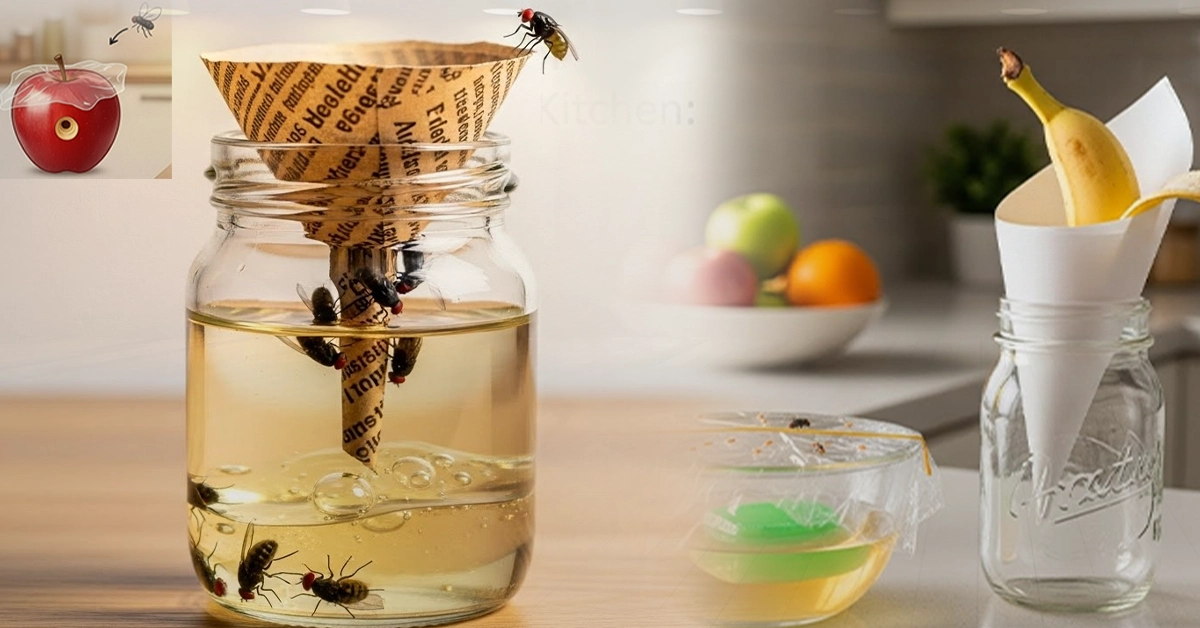
A Fruit and Plastic Wrap Trap
One of the best fruit fly traps for the home is the use of plastic wrap and fruit, if you do not have vinegar on hand.
Supplies
You need a chunk of overripe fruit, a piece of plastic wrap, a small bowl or a glass, a toothpick, and a rubber band.
Steps
- Place the piece of fruit (it can be a banana, melon, or an apple) in a small bowl or a glass.
- Stretch the plastic wrap and cover the opening of the container. Secure it with a rubber band.
- Use the toothpick to poke a few tiny holes in the wrap so that flies get lured in by the fruit. However, they won’t be able to escape easily.
- Place this bait near the fruit fly infestation site in the kitchen. Wait for around 12 hours to see the results. You can make a few of them and place them around the room for more effective results.
- Clean the container(s) and remake the trap every few days until the infestation properly goes away.
A Paper Cone Trap
The concept of this trap is similar to that of vinegar and dish soap. In this bait, the funnel is easy to enter but difficult for fruit flies to escape.
Supplies
You need vinegar or a chunk of an overripe fruit, a glass or a jar, a sheet of paper, and scissors.
Steps
- Place the vinegar or fruit at the bottom of the glass.
- Roll the piece of paper to make a cone-like shape. Snip the tip slightly to create a very small opening.
- Put your cone in the glass, tip-down. Leave a little space between the bait and the paper.
- Place the trap near your trash can, sink, fruit bowl, or any other area where you notice the infestation.
- Keep remaking the bait every few days for maximum results.
Homemade Fruit Fly Spray
Another quick and effective way to clear these pests out is through alcohol spray.
Supplies
You just need two things: rubbing alcohol and a spray bottle.
Steps
- Fill the spray bottle with 91% isopropyl alcohol.
- Spray it directly on fruit flies. However, avoid spraying it on your fruit. It is unsuitable for consumption, and it also damages the fruit’s skin, making it spoil faster.
Store-Bought Fruit Fly Control Methods
If you do not want to rely on DIY traps, you can buy premade traps. Many traps remain effective for a few weeks.
Some store sprays for indoor pest control not only kill fruit flies but also ants, roaches, moths, and spiders. You can buy these from online stores or visit shops that deal with pest control.
What Do Smells Fruit Flies Hate?
Some natural fruit fly remedies also include using different smells that fruit flies absolutely hate. One of them is the scent of herbs. You can hang fresh sprigs in the kitchen or grind some herbs and keep them near your fruit bowl.
Fruit flies cannot stand the smell, keeping them at bay. Another idea is to grow a small herb garden inside your kitchen. Not only will it keep away the flies, but you will also get fresh ingredients for your cooking.
Some other off-putting scents are the fragrance of essential oils, like lemongrass, peppermint, eucalyptus, and tea tree. If you have a diffuser, add some drops of essential oil to it.
Or you can add it to water and spray the mix around the home. The fun fact is that the smell of essential oils keeps away many insects, including fruit flies. You will also get rid of spiders, moths, ants, and mosquitoes at the same time.
Fruit Flies vs Gnats: Identify Your Pest
Fruit flies and gnats, particularly fungus gnats, are often confused because of their similar appearance and cause the same issues inside the house. These two pests are different and require different approaches for control. Fruit flies are similar to gnats, but they belong to a different insect order.
| Feature | Fruit Flies | Gnats |
| Color | Light brown, tan, or yellowish body with red or dark eyes | Black, gray, or dark brown |
| Body Shape | Short, stout body | Slender, mosquito-like body |
| Primary Attraction | Overripe fruit, fermenting food, sugary liquids | Moist soil, decaying organic matter, fungi |
| Common Indoor Locations | Kitchens, trash cans, sinks, drains | Near houseplants, damp areas, and windows |
| Breeding Sites | Fermenting fruits, garbage, and drains | Wet soil, compost, standing water |
| Do They Bite? | No | Most do not; some outdoor gnats can bite |
| Typical Lifespan | 30–50 days | 7–30 days depending on species |
| Primary Cause of Infestation | Exposed food or unclean kitchen surfaces | Overwatered plants or excess moisture |
| Most Effective Control | Vinegar traps, removing food sources, and cleaning drains | Reducing moisture, drying soil, sticky traps |
Accurate identification matters because apple cider vinegar might work for fruit flies, but this method is not suitable for getting rid of gnats. For them, you need soil treatments and sticky traps placed near plants.
Are Fruit Flies Harmful to Humans?
Fruit flies do not sting or bite humans, and they also do not carry diseases. However, they do carry bacteria from dirty places to clean ones, like from garbage cans to the apples you keep on your countertop.
The bacteria can contaminate your food and cause listeria, E. coli, and Salmonella. This is why it is important to get rid of them as soon as possible. Additionally, it is a good reminder to wash your fruits and vegetables, even if you are grabbing them from your countertop.
How to Prevent Fruit Flies
Here are some fruit fly prevention tips that will keep these annoying bugs away from your kitchen.
Throw Away Overripe Fruit
The fruit flies come into your kitchen because your fruits are past their peak. Once you see they are overripe, get rid of them. You will be throwing away a major fruit fly magnet.
Keep Your Countertops Clean
Focus on small crumbs and spills on your kitchen counters and tables, along with throwing away overripe fruits.
These little pests get attracted to the smell of rotting food, whether it is in a very small quantity. Wipe every surface, including your floors, with soap and water or with a kitchen cleaner.
Wash Produce Properly
Wash the produce thoroughly when you bring it home from the farmers’ market or the grocery store. Keep what you can in the fridge away from these tiny pests.
Before eating, wash your produce to remove fruit fly eggs that may be on the surface of them.
Take Care of Kitchen Drains
If you are seeing fruit flies coming from the drain, you need to clean it immediately. Sink drains also collect food scraps, which attract fruit flies.
Clean your sink and drain areas regularly, as you do your countertops. You can pour boiling water into the drain hole to clean out any stuck food remains.
Keep your Fridge Tidy
Your refrigerator is a fly-free zone. They cannot go inside, and if they do, they cannot survive the cold temperature. However, spills on the exterior of the fridge also attract these pests.
Wipe the door, handle, and gasket areas. If you notice fruit flies flying around your crisper drawer, check if the fridge door closes completely.
Throw your Garbage
Throwing your spoiled and sticky food remains in the garbage and recycling cans is like a buffet for fruit flies. Clean your bins daily and also wipe any residual spills and crumbs.
Repair Windows and Screens
Check for any holes and cracks in windows and screens to avoid making it easy for fruit flies to enter your kitchen. If you have a window air conditioner, you also need to check its perimeter for any gaps.
Do not Purchase Damaged Produce
Make sure to properly check fruits and vegetables to avoid buying any damaged produce from the grocery store or farmers’ market. Otherwise, you are allowing fruit flies to invade your house.
In a Nutshell
If you are also worried about how to get rid of fruit flies in kitchen, you only need some DIY methods to clear them for good. Whether you use the spray method, vinegar method, or essential oils, these proven approaches keep these pesky little bugs away.
Want to make your house a peaceful sanctuary? Read more detailed blogs on Home Improvement Advise.
FAQs
Why is my Home Suddenly Full of Fruit Flies?
Fruit flies come into your house when they are attracted to rotting organic produce or spills. They can also invade your place through cracks in windows and through the eggs laid inside the produce you get from a grocery store. They seem to come out of nowhere, but it mainly happens due to their fast breeding and development.
Why do Fruit Flies Keep Coming Back into my Kitchen even after cleaning?
Fruit flies often come back because their eggs and larvae remain hidden in trash cans, drains, and damp areas. Even small food residues are enough to restart an infestation in your kitchen.
What is the Fastest Way to Get Rid of Fruit Flies?
The fastest method to clear away these pests is the combination of cleaning and using an apple cider vinegar and dish soap solution. This approach kills the adult flies and prevents the eggs from hatching.
Are DIY methods of killing Fruit Flies Better compared to Store-bought ones?
DIY fruit fly traps are as effective for mild infestations as commercial methods. However, if it is a large or recurring infestation, store-bought options are better.
How can You Prevent Fruit Flies from Coming Back Long-term?
Long-term prevention needs proper care of the kitchen, such as cleaning drains, wiping countertops and floor, throwing garbage daily, and keeping your produce in the fridge.
What are Non-Toxic Sprays to Kill Fruit Flies Indoors?
You can use 91% isopropyl alcohol in a spray bottle to get rid of these flies. Another spray is mixing a few drops of peppermint, eucalyptus, and lavender oils in water to keep these pests at bay.