20-Second Summary
A successful garden begins with a good foundation, and there is nothing more important than a garden with good soil conditions. So to grow a better garden, you will need to understand soil types.
The quality of the soil in your garden decides if your plants can thrive or die. In this guide, we’ll show you how to identify what type of soil you have. Whether it’s clay soil, sandy soil, loamy soil, silt soil, peaty soil, or chalky soil.
We’ll teach you how to test soil pH, understand what those numbers mean, and learn which amendments like compost and organic matter will actually help. By the end, you’ll know exactly how to prepare fertile soil that grows healthy plants.
Why Your Soil Matters More Than You Think
Think of soil like salt or sugar when making a recipe. If you forget to add salt to savoury dishes or forget sugar in desserts, you will end up with a poor recipe. Similarly, soil is the main ingredient for the growth of your home garden plants, whether you are doing in-ground or container gardening.

The type of soil you have in your garden tells you the amount of water, fertilizers, and other soil mix you need so that your plants can absorb maximum nutrients to grow stronger and harvest at an optimal level.
Having a good understanding of soil prepares you to fix the gardening problems before they occur. You can not only createperfect soil for your garden, but also grow successful plants in your home garden.
What Are the Six Main Soil Types?
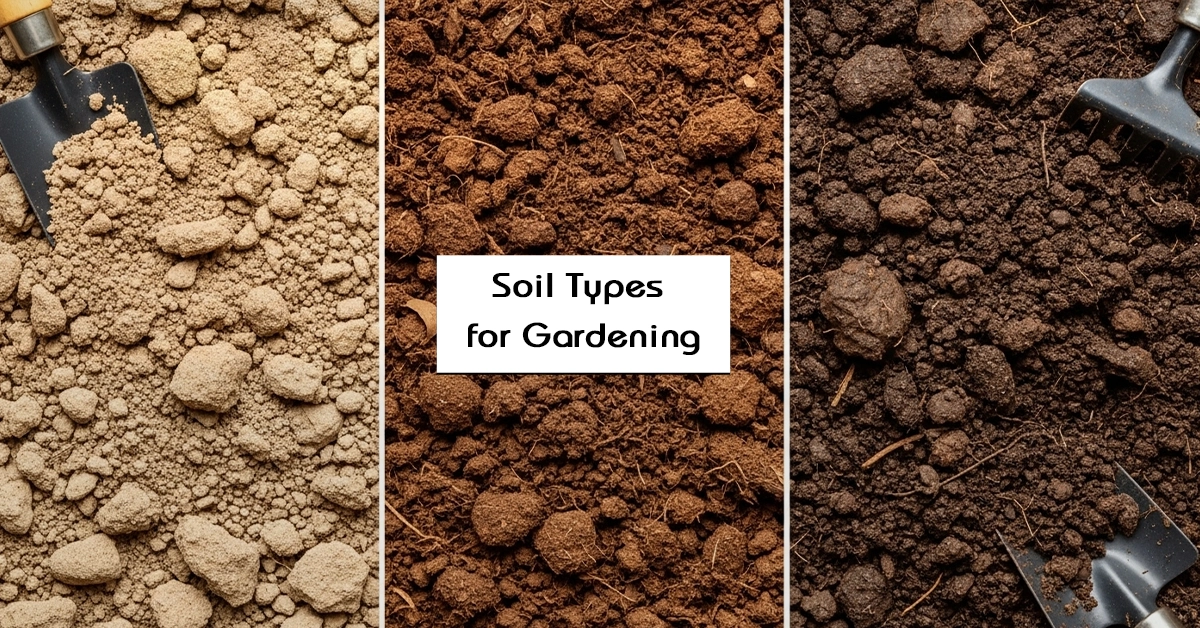
There are six main soil types. Each type has its own behaviour. They drain water differently, have different nutrient levels, and require different amendments to give good gardening results.
| Soil Type | Soil Texture / Trait | Nutrient Content & pH | What Grows Best | Key Characteristics / Tips |
| Clay Soil | Heavy soils, tiny clay particles, sticky when wet, hard when dry | Nutrient-rich soil, pH neutral to slightly acidic, 6.0–7.0 | Cabbage, broccoli, root crops, perennials | Holds moisture, poor drainage, compacts easily, slow to warm in spring, adding organic matter or compost improves soil structure and healthy plant growth |
| Sandy Soil | Coarse sand, sandy loam, large particles, loose, free-draining | Low nutrient content, washes away quickly, pH 5.5–7.0 | Root vegetables, carrots, radishes, herbs like lavender and oregano | Drains well, warms quickly, retains little water; adding organic fertilizer or glacial rock dust improves nutrient content and water retention |
| Loamy Soil | Equal amounts of sand, silt, and clay; perfect soil for gardening | Nutrient content high, pH 6.0–7.0, well-drained | Most vegetables, fruit trees, salad crops, and flowering quince | Holds moisture, drains well, easy to work with, adding compost maintains healthy soil, and plant roots thrive |
| Silt / Silty Soil | Smooth, silty particles, slippery when wet | Nutrient-rich soil, pH neutral to slightly acidic | Leafy greens, salad crops, and most vegetables | Holds more moisture than sandy soil, drains better than clay, compacts easily if walked on, and adding organic material prevents soil erosion and promotes plant growth |
| Peaty Soil | Dark, spongy, organic matter-rich, retains water | Acid soil, pH 4.0–5.0, high organic matter | Acid-loving plants like blueberries, cranberries, and azaleas | Holds moisture, may need adding lime or compost to raise pH for most plants, very fertile but waterlogged if unmanaged |
| Chalk / Chalky Soil | Calcium carbonate, chalk, chalky soils, large grains, free-draining | Low nutrients, alkaline soil, pH 7.5–8.5 | Cabbage, spinach, lavender, lilacs | Free-draining, dries quickly, metals like iron are locked up, adding organic matter or compost improves nutrient content, thrives in alkaline conditions |
How to Identify Your Soil Type: The Simple Squeeze Test
You can do a simple squeeze test at home to identify the soil type of your garden space. We have explained this method below:
Hand Test For Soil Identification
Step 1: Go outside and find a spot in your garden. Dig down about 6 inches, because to do this test, you will need the soil that has been sitting for some time and is not fresh compost.
Step 2: Get a handful of soil, which is slightly moist. If you have never used the soil and it is dry, then water the soil and test it after one day gap.
Step 3: Squeeze the soil in your hand and form a ball.
The results will identify the soil type:
- If the ball holds up together and does not fall apart upon throwing, then it is clay soil.
- If the soil is sandy, the ball will fall apart immediatel,y making it tough for you to hold it together.
- If the ball holds together loosely and crumbles upon leaving the holding forcewithout completely falling apart, it is loamy soil.
- If the ball holds together but feels very smooth and slippery, then it is slit soil.
Jar Test for Soil Identification
You can also do the jar test for more details.
- Fill a jar with water and soil, shake it up, and let it sit for 24 hours.
- The particles will separate into layers.
- Sand settles first, then silt, and then clay.
Seeing this will let you know which type of soil is more prevalent in your soil composition.
Understanding Soil pH: Why It Matters for Plant Growth
If your soil has all the nutrients, but its pH levels are not right, then plants will not be able to use the nutrients well. This can be understood with the concept of the nutrient availability spectrum.
The nutrient availability spectrum shows that at different pH levels, different nutrients become available or unavailable to the plants.
Let us now understand the pH levels of soil first, to see how it impacts the availability of the soil.
Soil pH is measured on a scale from 0 to 14:
- Neutral soil is 7.0
- Acid soil is below 7.0.
- Alkaline soil is above 7.0
For most vegetables and flowers, it’s between 6.0 and 7.0. At this pH, almost every nutrient is available. 6.5 is often called the “magic number” in gardening.
Let’s say if your soil pH is 8.0, iron becomes locked up even if it’s in the soil. Your plants can’t absorb it, so they get sick and turn yellow. The nutrient is there, but your plants can’t use it.
How to Test Your Soil pH: Four Methods Explained
Soil pH can be tested for free and with some tests that cost money. Below, we are going through each one.
| Method | How It Works | Cost | Time | Accuracy | Best For | Reliability of Results |
| Vinegar and Baking Soda Test | Mix a bit of soil with vinegar. If it bubbles, the soil is alkaline. If not, try baking soda. Bubbling means acidic. | Free | 5 minutes | Low | Quick, free check | Low reliability, only shows acidic, neutral, or alkaline. No exact pH. |
| Home pH Meter or Test Strips | Stick a pH meter into damp soil or dip a strip in soil and water. The meter gives a number and the strip changes color. | 10 to 30 dollars | 2 to 3 minutes | Around 80 percent | Home gardening, tracking changes | Medium reliability, gives approximate pH suitable for home use. |
| Professional Soil Test | Send a sample to a lab or university extension. They check pH, nutrients, and organic matter, then give recommendations. | 0 to 60 dollars | 1 to 2 weeks | 100 percent | Serious gardeners, problem-solving | Very high reliability, most accurate and detailed results. |
| Red Cabbage Test | Boil red cabbage and use the purple water on soil. Pink means acidic and blue means alkaline. | Free | 30 minutes plus | Low | Fun learning, educational | Low reliability, visual experiment only, not precise. |
What Your Soil pH Results Mean
Let’s see what your soil pH number means.
pH 4.0-5.0 (Very Acidic)
- It means that your soil is very acidic for some vegetables, and has aluminium available, which can be toxic to plants. This can be amended by adding lime inthe fall season, and this will raise pH gradually with time.
- Use 5-10 pounds per 100 square feet.
- It takes 3-6 months to work, which is why fall is the best time to apply it.
pH 5.5-6.5 (Slightly Acidic)
- This pH is good for most vegetables and many flowers. This is probably where your soil naturally is, especially if you live in the eastern or northern US, where there’s more rain.
- You will just need to add compost every year.
pH 6.5-7.0 (Neutral/Ideal)
- This is the perfect and ideal pH level. Plant nutrients are available. You’re in the sweet spot.
- You just need to add organic matter, like compost, annually to keep it balanced.
pH 7.0-8.0 (Slightly Alkaline)
- Now the soil is more on the alkaline side. Plant nutrients like iron become unavailable.
- To amend this, add compost and organic material, and choose plants that like this pH
- These plants may include: herbs, Mediterranean plants, cabbage, spinach.
pH 8.0+ (Very Alkaline)
- Iron, manganese, and other nutrients are locked up in this kind of pH-level soil.
- Chalky soil comes in this category of pH levels.
- You can either add sulfur to lower the pH or accept it and grow plants that like alkaline soil.
- Plants like: Lilacs, lavender, cabbage, spinach can grow well in this type of soil.
How to Improve Your Soil: The Main Amendments
Organic matter is the only amendment that you need to improve any type of soil. Let us see which organic matters work well for which soil and pH type.
| Amendment | Purpose | How to Use | Amount | Best Time | Cost | Suitable Soil / pH |
| Compost | Improves drainage in clay soil, retains water in sandy soil, adds nutrients, feeds soil organisms, and improves root growth | Spread on top of the garden bed and mix into the top 6 to 8 inches | 2 to 4 inches layer; 5 to 10 cubic yards per 100 sq ft | Fall (best) or spring | 50 to 150 dollars per 100 sq ft | All soils, all pH levels |
| Other Organic Matter (aged manure, shredded leaves, grass clippings, peat moss, straw) | Improves soil structure, adds nutrients, and slowly breaks down | Spread as a top layer and mix over time | 2 to 3 inches of layer | Any time, yearly for maintenance | Variable | All soils, all pH levels |
| Garden Lime (agricultural lime) | Raises soil pH | Spread evenly and mix into the soil | 5 to 10 pounds per 100 sq ft per 0.5 pH point increase | Fall (takes 3 to 6 months to work) | 10 to 20 dollars per 100 sq ft | Acidic soil (pH below 6.0) |
| Sulfur | Lowers soil pH | Spread evenly and mix into the soil | 1 to 2 pounds per 100 sq ft | Spring (takes 6 to 12 months to work) | Expensive | Alkaline soil (pH above 8.0) |
Common Soil Problems and How to Fix Them
There are four common soil problems that exist, and we are giving you their fixes below.
Problem 1: Your Garden Stays Waterlogged
It is usually due to clay soil or poor drainage.
To fix this:
- Add 3 to 4 inches of compost in the top 10 inches of your soil.
- Add a 2-3 inch layer of mulch on top to prevent a crust from forming.
- Consider raising beds to drain better than in-ground plots.
Problem 2: Your Soil Dries Out Too Fast
This is due to sandy soil or due to the lack of organic matter in the soil.
To fix this:
- Add 4-6 inches of compost.
- Water more frequently initially.
- Add a 3 to 4 inches thick mulch layer to protect against evaporation.
Problem 3: Yellow Leaves on Your Plants
This is due to low nutrients or the wrong soil pH.
To fix this:
- Get a soil test.
- Add compost or fertilizer if tests show low nutrients.
- Adjust pH if needed.
Problem 4: Hard, Crusty Soil
It happens because clay soil has been walked on or rained on without protection.
To fix this:
- Add organic matter and mulch.
- Stop walking on the beds.
- Consider raised beds to avoid amending heavy clay soil.
A Realistic Timeline: How Long Does Soil Improvement Actually Take?
Soil improvement requires a specific timeline,s and nothing will happen overnight.
- In the first year, you will add amendments and mulch. Changes will not be dramatic, and the plants might still struggle a bit because the soil is still settling.
- In the second year, you should add another layer of compost, which will make the soil structure better, reducing the problems, and helping the plants grow better.
- Over the next 3 years, your soil will naturally become healthier. It will have soil organisms and not require fertilizer like before due to the natural cycling of nutrients.
Final Remarks
Not everyone has a garden with good soil. You can test your soil, and then improve it based on the pH levels for the plants or vegetables you wish to grow in your garden.
Not having ideal soil should not discourage you, because you can grow the plants for the current soil pH levels, and improve the soil in upcoming seasons by making the required amendments.
Every successful garden is built from the ground up. Tools, fertilizers, and plant choices matter, but soil matters most. When you take care of your soil, it takes care of your plants. Improve it slowly, work with it instead of against it, and your garden will thrive year after year.
Check out our other guides: Learn how to start a garden step-by-step for the next steps, or explore the best vegetables to grow once your soil is ready.
Frequently Asked Questions
1. What’s the best soil pH for most plants?
Most plants are happy at pH 6.5. This is where the most nutrients are available.
2. Can you change the soil type?
You can’t change clay soil into sandy soil. But you can improve its performance by adding organic materials. You can improve drainage by 300% by just adding the compost. Adding it to sandy soil can improve water retention by the same amount. The improvements happen over 2-3 years.
3. How often should I test my soil?
Get a full professional test once before starting gardening so that you can set a strong foundation. After that, test every 3-5 years. You can test for pH levels yearly at home, but it is not necessary if there are no visible problems.
4. How can I tell if my soil is healthy?
Healthy soil has lots of earthworms, smells earthy, and is dark colored. It has a crumbly structure and holds moisture but drains well. If your plants are growing well without needing constant fertilizer, that’s a good sign too.
5. How do I know if my soil is acidic or alkaline without a test?
Use the quick vinegar and baking soda test. Put a handful of soil in a cup. Add vinegar. If it fizzes, your soil is alkaline. If it doesn’t fizz, add baking soda. If that fizzes, your soil is acidic.
6. What’s the difference between clay, silt, and loam?
Clay soil is made of very tiny clay particles. It holds together when squeezed and stays wet. Silt soil has medium-sized particles and feels smooth when wet. Loam is a mix of equal amounts of sand, silt, and clay.
7. Do I need to test my soil every year?
No. Get a full soil test once to establish a baseline. After that, test every 3-5 years. For quick pH checks, use a home pH meter once a year.