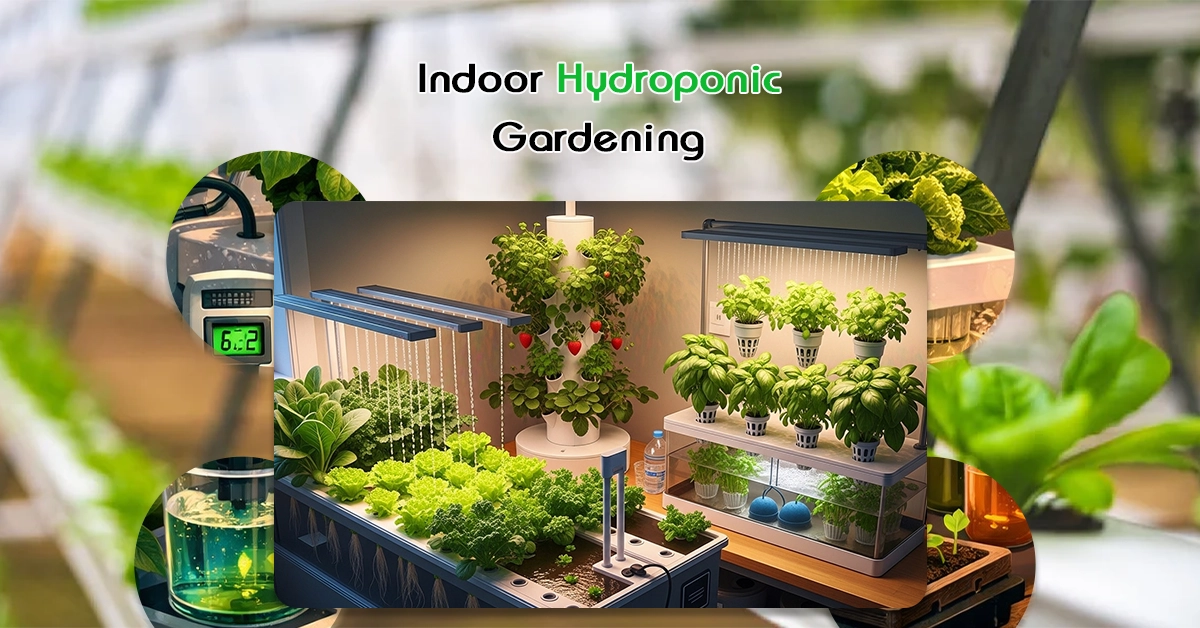
Do you want to start indoor hydroponic gardening? You have come to the right place. In this guide, we will tell you everything about this revolutionary method of growing plants, including its benefits, types, the best plants you can choose, and how to set it up in your house.
TL;DR
- Indoor hydroponic gardening allows plants to grow faster and yield more by delivering all the nutrients directly to the roots.
- Beginners should always start with simple systems like countertop kits or DWC before moving to advanced systems.
- Proper pH balance, lighting, and nutrient monitoring are important for healthy plant growth.
- Hydroponics saves you space and water while delivering produce year-round.
What Is Hydroponic Gardening?
Hydroponic gardening is a process of growing crops in nutrient-rich water rather than soil. Plants get what they need, growing 25% faster than with traditional methods.

How It Works
In hydroponic systems, plants grow their roots in water that has all the essential nutrients. These systems also use inert growing medium (non-organic, sterile materials) for moisture retention and mechanical support. These inert mediums include clay pellets, rockwool, perlite, coco coir, and vermiculite.
As soil has no role in this method, your plants remain safe from diseases and pests. This system gives you complete control over your plant nutrition. As a result, the plants focus their energy toward growth rather than expanding their roots to search for nutrients as they do in soil.
Benefits of Growing Plants Hydroponically Indoors
There are multiple benefits of hydroponic systems.
- Faster Growth: Plants grow faster with this method than with traditional gardening because they have direct access to nutrients. For instance, lettuce can be harvested in 25 to 30 days hydroponically compared to 45 to 60 days in soil.
- More Produce: Plants grown hydroponically have higher yields because of proper nutrients and environmental conditions. They produce leafy greens, fruits, and vegetables in less time than traditional gardening.
- Reduced Pests or Diseases: Hydroponic gardening is done in a controlled environment. This is why the risk of pests and diseases is way lower. This also eliminates the need for pesticides and other chemical treatments.
- Space Saving: These plants can be grown in small spaces, making them great for apartments, urban gardeners, and houses with less outdoor space.
- Water Conservation: Hydroponic systems recirculate water, significantly reducing water waste compared to traditional gardening.
Types of Indoor Hydroponic Systems
Indoor hydroponic systems differ in complexity, cost, and maintenance needs. Beginners should understand how each system works before choosing one.
- Deep Water Culture (DWC): In this system, plant roots are submerged in water, and oxygen is provided through air stones or diffusers. It is a cost-effective method perfect for beginners.
- Nutrient Film Technique (NFT): This system includes a thin film of nutrients flowing over the roots of the plants. The excess nutrients are collected and recirculated, making it a simple method for growing your own plants indoors.
- Drip System: It includes a timer-controlled drip pump that delivers a nutrient-rich solution to plants via drip emitters. It allows you to control the precise amount of nutrients your plants need.
- Aeroponics: In this system, plants are suspended in the air, and their roots are misted with nutrient water. This method provides oxygenation to the roots and results in higher growth.
- Wick System: This system does not need any pumps or electricity. It uses a wick to draw nutrients to the roots.
Components of an Indoor Hydroponic Garden
Here are some components you need to start a hydroponic garden.
- Containers or plant pots: You can use trays, buckets, or special containers designed for hydroponic gardening.
- Growing medium: The medium (coconut coir, wood perlite, etc) should be able to support the plants and their roots.
- Nutrient solution: This solution should contain macronutrients and micronutrients in appropriate amounts and include pH adjusters to support proper growth.
- Lighting: LED lights are great because they are energy-efficient and provide the right light spectrum for your plants’ growth.
- pH and TDS meters: These tools are important to monitor the pH and nutrient levels to ensure that plants get everything in balance.
- Water pump: It circulates the nutrient-rich water and provides oxygen to the plant’s roots.
Hydroponic Setup for Beginners (Step-by-Step)
Here is how to set up a hydroponic garden indoors.
Research and Plan
Start by researching different types of hydroponic plants and their specific needs. Choose those that best fit your requirements and available space.
Set Up Your System
Purchase all the essential components for your plants. Assemble the system in an ideal location with access to electricity, water, and ventilation.
Prepare the Nutrient-rich Water
Follow the instructions that come with the hydroponic nutrient package. Moreover, adjust the pH and TDS levels as instructed.
Plant Your Crops
Take seeds or young seedlings and place them in the growing medium. Make sure the medium properly covers and supports the roots.
Monitor Your Plants
After planting, monitor your crops’ growth, pH, and TDS levels. Look for the signs of nutrient deficiencies and take action immediately.
Enjoy the Produce
You will soon see the results of your hard work. Enjoy fruits, vegetables, and leafy greens. However, you should keep in mind that the hydroponic method is based on trial and error. You may need to adjust the system a few times before getting the correct balance of environment and nutrients.
Best Plants for Indoor Hydroponics
Using a hydroponic system, you can grow a variety of crops, including
- Kale
- Spinach
- Lettuce
- Jalapenos or Thai chili
- Mint
- Basil
- Strawberries
- Cilantro
- Cherry tomatoes
Nutrients and pH Management
Maintaining a hydroponic system means balancing the nutrient solution to the right pH and Electrical Conductivity (EC) levels for each stage of your plant’s growth.
Nutrient Management
- To determine nutrient concentration, you need to measure Electrical Conductivity. Higher EC signals more nutrient salts.
- General nutrient levels differ. However, keep EC 1.2–2.0 mS/cm for most crops. Young seedlings need a lower concentration than flowering plants.
- Do not mix nutrients with each other to avoid nutrient precipitation. Always use water for nutrient mixing. Add macronutrients first, followed by micronutrients.
- If EC is high, dilute it with fresh water. If it is low, add concentrated nutrient solution.
- Make sure to completely replace the nutrient solution every 1 to 2 weeks to avoid nutrient imbalance or toxicity.
pH Management
- The pH level should be slightly acidic, around 5.5 to 6.5, to ensure all nutrients remain available for root uptake.
- Always use a calibrated pH meter to test the levels. Fluctuations are normal, but they should not spike quickly.
- To lower pH, use phosphoric or citric acid. To increase it, use potassium hydroxide. Add small amounts and allow these nutrients to fully mix before testing the pH again.
- If you are using hard water, you may need a Reverse Osmosis system to prevent constant high pH. Reverse Osmosis is a process in which water flows through a semi-permeable membrane to remove impurities and pollutants, resulting in purified water.
Ready-Made Kits vs DIY Systems
| Feature | Ready-Made Hydroponic Kits | DIY Hydroponic Systems |
| Setup Difficulty | Very easy (plug and grow) | Moderate to difficult |
| Cost | Higher upfront cost | Budget-friendly |
| Customization | Limited | Highly customizable |
| Time Required | Minimal setup time | Requires planning and building |
| Maintenance | Often automated | Manual monitoring needed |
| Learning Curve | Beginner-friendly | Better for hobbyists/learners |
| Scalability | Limited expansion | Easy to scale or modify |
| Aesthetic Design | Clean and modern | Depends on DIY skills |
Hydroponics vs Aquaponics Indoors
| Feature | Hydroponics | Aquaponics |
| Growing Method | Plants grow in a nutrient solution | Plants grow using fish waste nutrients |
| Soil Use | No soil | No soil |
| Complexity | Easier to manage | More complex ecosystem |
| Setup Cost | Moderate | Higher (tank + fish system) |
| Maintenance | Nutrient & pH monitoring | Fish care + water balance |
| Growth Speed | Usually faster | Slightly slower |
| Sustainability | Water efficient | Highly sustainable closed loop |
| Beginner Suitability | Very beginner-friendly | Better for advanced growers |
Common Problems and Troubleshooting
Indoor hydroponic systems for beginners may be confusing at first. Here are some common problems you might face and their solutions.
Root Rot
Root rot means the roots of your plants are becoming brown, slimy, or smelly. The reason is either low oxygen or stagnant water.
Solution: Improve aeration using an air pump or air stone. Make sure to change the nutrient solution regularly and keep the water temperature between 18 and 22°C.
Algae Growth
A layer of green substance forms on the water’s surface or the container’s walls. The reason is usually the nutrient solution’s exposure to light.
Solution: Use opaque containers, cover the exposed water areas, and clean the containers and other parts of the system regularly.
Nutrient Burn
The sign of nutrient burn is the leaves of your plants turning brown or crunchy. The cause is excess nutrient concentration.
Solution: Dilute the nutrient solution using fresh water and closely monitor the EC levels. Always follow the recommended feeding schedule to avoid this issue.
Yellow Leaves
When you notice your plants’ leaves turning yellow, the cause is usually a nutrient imbalance or pH issues.
Solution: Adjust the pH between 5.5 and 6.5, use complete hydroponic nutrients, and make sure to replace the old solution.
Slow Plant Growth
If your plants are growing weaker or slower than expected, it is usually because of poor lighting, low nutrients, or incorrect temperature.
Solution: Increase light intensity or duration. Keep your room temperature between 20 and 26°C and ensure the nutrient strength is appropriate.
Cost, Yield, and Long-Term Sustainability
Costs
Small countertop hydroponic systems may cost around $100, while larger indoor systems can exceed $1000. You also need to consider operational costs, including electricity, nutrients, and supplies.
Yield
Proper nutrient and environmental management results in 30 to 50 percent faster plant growth and more than 30% higher yields. These faster growth rates allow for more harvests every year.
High yields also depend on the type of crop you choose. For instance, herbs, strawberries, and tomatoes are among the most profitable crops.
Sustainability
Hydroponic systems are considered extremely sustainable because they reduce dependency on water and arable land. These systems are closed-loop, therefore reducing water consumption by 90% compared to traditional farming.
They are also environmentally friendly. Lowering the risk of pest infestation reduces the need for chemical pesticides, which is better for your family and pets.
Beginner Mistakes to Avoid
Avoid these mistakes to set up your indoor hydroponic system successfully.
- Ignoring pH monitoring
- Overfeeding your plants
- Using weak or inadequate lighting
- Keeping plant containers dirty
- Inconsistent water levels
- Starting with complex systems
- Choosing large plants for small systems
Who Should Use Hydroponics?
Hydroponics are great for
- People who live in apartments and have no outside space to grow plants
- Urban gardeners who want clean and soil-free gardening
- People who want plants to produce all year round
- People who like to garden as a hobby
- Tech-savvy gardeners who like to enjoy new technology
Wrapping Up
Indoor hydroponic gardening is a convenient way to grow plants. It has been proven to produce higher yields than traditional gardening and is an environmentally friendly solution. Start small with one or two crops, do your homework, and keep monitoring your plants’ health to make adjustments as needed.
Interested in growing your indoor garden? Visit Home Improvement Advise for more blogs.
FAQs
Is Indoor Hydroponic Gardening Safe for Food Crops?
Yes, in fact, hydroponic gardening is excellent for growing edible crops. Just make sure to use food-grade nutrients and maintain proper pH and cleanliness.
Which is the Easiest Indoor Hydroponic System for Beginners?
For beginners, the best system is Deep Water Culture (DWC). It has fewer moving parts and is affordable to set up.
Can Hydroponic Plants Grow without Sunlight Indoors?
Yes, hydroponic plants can grow entirely indoors with LED grow lights that provide the appropriate light spectrum and duration.
Is Hydroponic Gardening More Affordable than Traditional Gardening?
Hydroponic gardening is not cheaper than traditional gardening in terms of high upfront costs. However, it becomes cost-effective over time due to faster growth, higher yields, and reduced water usage.
Do Hydroponic Plants taste different from Soil-grown Plants?
Yes, the taste of plants is slightly different, but it is very subtle to notice. A hydroponic plant’s flavor is described as cleaner, crisper, and more consistent. However, it all depends on nutrient management.